Time to return to Kunz’s Curious Lore of Precious Stones.
Lapis-Lazuli
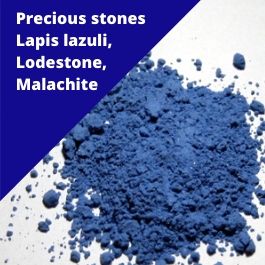
Lapis Lazuli is a vibrantly blue semiprecious stone, but to Mythic Europeans, it’s a terribly rare thing. First,. let me note that when I was a lad, we were told all of that blue material in Egyptian art was lapis lazuli. This is simply not true. The Egyptians did have access to lapis lazuli, and used it for jewellery, but far less than I thought.
Imagine, if you will, the mask of King Tutankhamen. The broad horizontal blue stripes in his head-dress are not lapis lazuli. There’s a tiny amount of lapis lazuli in the mask: it’s in his eyes and eyebrows. That other material is, I believe, a sort of fired porcelain coloured with a mineral called Egyptian Blue. The Romans called this other material caeruleum, which lets me rope in the discussion of Cerulean Blue we had in a previous episode. Unhelpfully what we now call lapis lazuli the Imperial Romans called sapphirus, which leads to the question of if the Biblical sapphires are really lapis lazuli.
The modern name first emerges in the Middle Ages. Ground into a dye, it has been found in European materials from before the game period, but not in great quantity. A century after the game period, it was the most expensive pigment known to Italian artists. Yes, it was even more expensive than murex purple, our old favourite. It’s worth more than its weight in gold. The name for the dye, ultramarine, is literal: Italians imported it from “over the sea” in Asia Minor.
There are two reasons why ultramarine is so expensive. During the game period, it is only mined in one place in the world: a small region of what is now north-eastrsn Afghanistan. The second problem is a technical one: Even once the lapis lazuli is mined, it needs to be processed to make ultramarine. At the start of the 13th century, Europeans found a way of grinding lapis lazuli so that it didn’t just become grey dust. The process is time consuming and uses caustics like lye to remove the impurities from the ground stone.
Kunz notes that “Lapis-lazuli, “a blue stone with little golden spots,” was a cure for melancholy and for the “quartern fever,” an intermittent fever returning each third day, or each fourth day counting in the previous attack.” The gold spots were one way of telling what we now call lapis lazuli from what we now call sapphire.
The current rules give Lapis Lazuli: keep limbs healthy 5, cure boils and ulcers 5, obsession power of demons 6. Lapis Lazuli (powder) aphrodisiac 3 but I’m not sure where any of that comes from, folkloristically. I’d like to note that I gave the Jerbion blue and gold robes in Sanctuary of Ice. That’s even more deliberately opulent now we know that ultramarine and gold are literally the two most expensive pigments. You could argue that this is a hint the Jerbitons have some sort of settlement in the far EAst: some of their brethren occasionally head out along the Silk Road.
Loadstone
For this stone I’ll be quoting Kunz heavily. Before launching in, I’d like to note that “lode” is an archaic English word meaning to travel, and that the European discovery of these stones may have been by Anatolian Greeks, around Magnesia. Lodestones are made of a mineral called magnetite, which is found in several places in Mythic Europe. How it gets magnetised is a bit of a puzzle to ancient people: it the modern day we thin it is because of the the magnetic fields which surround lightning strikes. I’d note that Switzerland, which is the home of one of the many commercial deposits of magnetite, is also the home of the Lightning tradition in House Flambeau. It may be it assists their magic.
In the modern day, magnetite is mined for iron. The objects made from this might have different properties, for enchantment, to things made from meteoric, geolithic or bog iron.
I went to University in Townsville, and the island sheltering the harbour is Magnetic Island. Captain Cook named it that because it was mucking with is compass. Oddly the lodestones there are laying in reverse to what you’d expect – the magnetic north end points toward the geographic south. This is because they were laid down when the Earth;s poles were in reversed positions to what they are today. I’ve no proof of similar “reversed” lodestones in Mythic Europe, but I love the idea they can be used as shielding against the vim field, much as lead can be used to block radiation.
We have the authority of Plato for the statement that the word magnetis was first applied to the loadstone by the tragic poet Euripides, the more usual name being “the Heraclean stone.” These designations refer to two places in Lydia, Magnesia and Herakleia, where the mineral was found. Pliny states, on the authority of Nicander, that a certain Magnes, a shepherd, discovered the mineral on Mount Ida, while pasturing his flock, because the nails of his shoes clung to a piece of it.
We are told by Pliny that Ptolemy Philadelphus, planning to erect a temple in honor of his sister and wife Arsinoë, called in the aid of Chirocrates, an Alexandrian architect. The latter engaged to place therein an iron statue of Arsinoë which should appear to hang in mid-air without support. However, both the Egyptian king and his architect died before the design could be realized.This story of an image held in suspense by means of powerful magnets set in the floor and roof, and sometimes also in the walls of a temple, is repeated in a variety of forms by early writers. Of course, there was no real foundation for such tales, as the thing is altogether impracticable.
The Roman poet Claudian (fifth century a.d.) relates that the priests of a certain temple, in order to offer a dramatic spectacle to the eyes of the worshippers, caused two statues to be executed,—one of Mars in iron, and another of Venus in loadstone. At a special festival these statues were placed near to each other, and the loadstone drew the iron to itself.
There was current as early as the fourth century a curious belief that a piece of loadstone, if placed beneath the pillow of a sleeping wife, would act as a touchstone of her virtue. This first appears in the Alexandrian poem “Lithica,”
The same writer attempts an explanation of the popular fancy that when powdered loadstone was thrown upon coals in the four corners of a house, the inmates would feel as though the house were falling down; of this he says: “That seemynge is by mevynge [moving] that comyth by tornynge of the brayn.”
In classical writings the fascination exercised by a very beautiful woman is sometimes likened to the attractive power of the loadstone, as notably by Lucian, who says that if such a woman looks at a man she draws him to her, and leads him whither she will, just as the loadstone draws the iron. To the same idea is probably due the fact that in several languages the name given to the loadstone indicates that its peculiar power was conceived to be a manifestation of the sympathy or love of one mineral substance for another.
I’d note here Kunz is failing to account for Lucian being a satirist. He’s not suggesting this seriously, much as he does not seriously suggest in True Story that he actually visited the moon.
A rich growth of Mohammedan legends grew up about the exploits of Alexander the Great, a striking example being given on another page, and in one of them it is related that the Greek world-conqueror provided his soldiers with loadstones as a defence against the wiles of the jinns, or evil spirits; the loadstone, as well as magnetized iron, being regarded as a sure defence against enchantments and all the machinations of malignant spirits
A man in armor, graven on a magnet, or loadstone, has the power to aid in incantations and makes the wearer victorious in war.
I think the current rules give shape and material bonuses for magnets as : Rego 2, Rego Corpus 4, Rego Terram 4, Animal 3. Clearly this should be pushed out to Travel +9. It’s literally in the name.
Malachite
Malachite is what happens when copper ores weather: for example I sometimes teach children how to make penny batteries in my library, and this produces a layer of malachite on the coins. I’m fond of it, myself, because it has a lovely green colour, like the leaves of the mallow plant, which is loosely where it derives its name from. In mythic Europe the biggest deposits of Malachite are in Lyon and, I presume, Wales. The Welsh mines were pre-Roman, though, so it might have been exhausted. Malachite is mined to melt down for copper.
For some reason not easy to fathom, malachite was considered to be a talisman peculiarly appropriate for children. If a piece of this stone were attached to an infant’s cradle, all evil spirits were held aloof and the child slept soundly and peacefully. In some parts of Germany, malachite shared with turquoise the repute of protecting the wearer from danger in falling, and it also gave warning of approaching disaster by breaking into several pieces. This material was well known to the ancient Egyptians, malachite mines having been worked between Suez and Sinai as early as 4000 b.c.
The appropriate design to be engraved upon malachite was the image of the sun. Such a gem became a powerful talisman and protected the wearer from enchantments, from evil spirits, and from the attacks of venomous creatures.The sun, as the source of all light, was generally regarded as the deadly enemy of necromancers, witches, and demons, who delighted in the darkness and feared nothing more than the bright light of day.
Because of its peculiar markings, some of which suggest the form of an eye, malachite was worn in some parts of Italy (e.g., in Bettona) as an amulet to protect the wearer from the spell of the Evil Eye. Such stones were called “peacock-stones,” from their resemblance in color and marking to the peacock’s tail. The form of these malachite amulets is usually triangular, and they were mounted in silver. It is curious to note, as a proof of the persistence of superstitions, that in an Etruscan tomb at Chiusi there was found a triangular, perforated piece of glass, each angle terminating in an eye formed of glass of various colors.
I don’t think malachite is in the current shape and material table, but I’d suggest causing sleep +7, protecting children +6, protection +3. As such it’s particularly suited as a stone to be used for items designed to protect apprentices, either on adventure, or when assisting in laboratory work.


Hmm I can’t actually recall where I sourced the lapis lazuli S&M bonus inspiration but pretty sure it was from a text. I think it was something more Middle Eastern than European gemstone related actually…
LikeLiked by 1 person